
Case Study — Oil & Gas
How Four Winds helped a major oil and gas partner turn logistical ideas into reality.
Summary
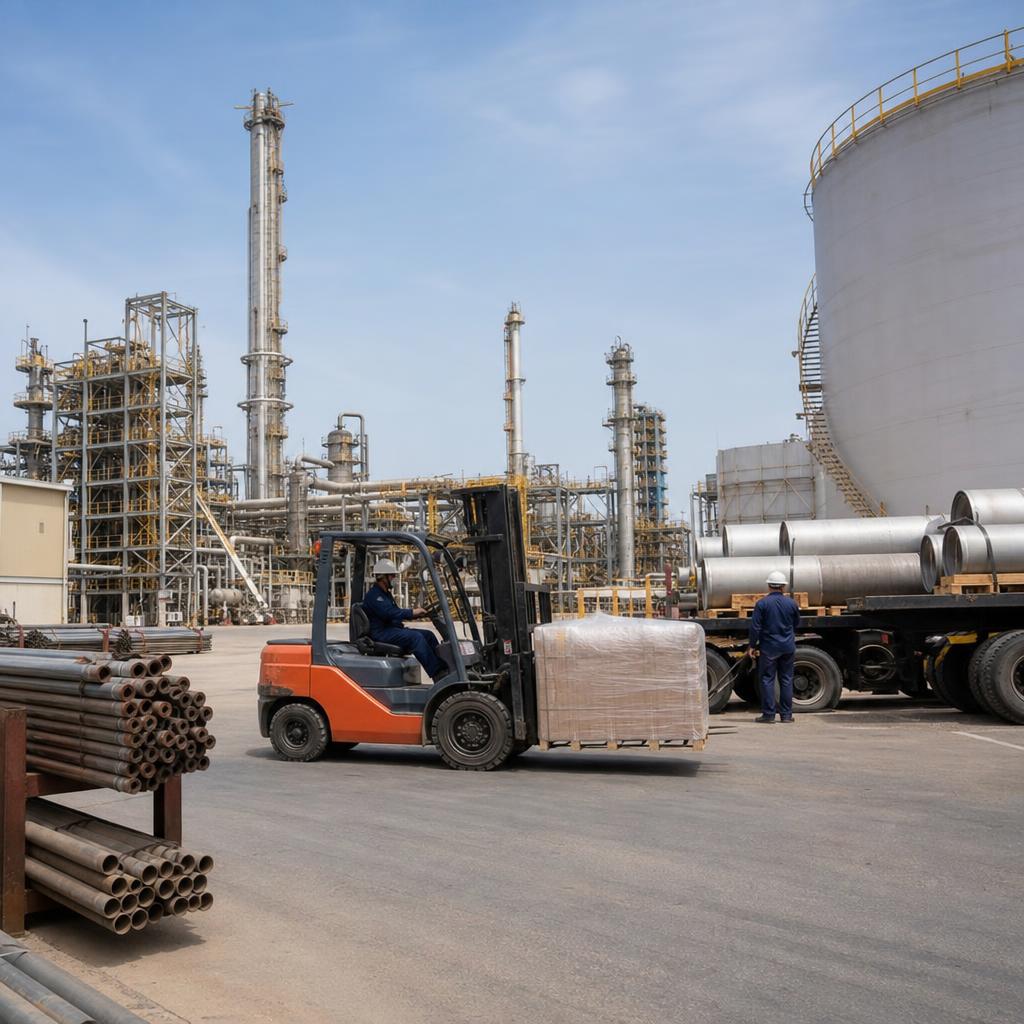
The client, one of Saudi Arabia's leanest oil refineries, has worked with Four Winds on several initiatives. As its lead logistics provider, the Four Winds team works closely with the customer to streamline operations and create and maintain a more centralized logistics network. Together, they uncovered several areas for real cost savings by reducing inbound carrier discrepancies, eliminating unnecessary premium costs and reducing shipment overages. Four Winds also implemented accountability procedures and advanced logistics management technologies to gain more visibility of the overall supply network.
Challenges
- Develop, implement and operate a centralized logistics network for the customer
- Maintain and elevate levels of safety compliance with a zero-incident rate
- Provide the customer with real-time supply chain and financial visibility
Solutions & Results
- Four Winds consolidated shipments to plants. Approximately 180 trailers ship to and from the customer's facilities every year, with most trucks at 90 percent capacity. Four Winds has reduced plant inventory by 15 percent.
- Four Winds trained suppliers on a uniform set of procedures and logistics technologies. Stringent carrier requirements and a Carrier Rating System were implemented to measure carrier performance.
- Four Winds implemented new logistics management technologies to gain real-time visibility of delivery status, routing schedules and productivity.
Getting Started
Four Winds began its relationship with the customer as lead logistics provider (LLP) for the facility in Saudi Arabia in 1997. At that time, all of the customer's plants managed their own logistics operations. A decentralized approach provided total control of logistics at the plant level, but presented costly redundancies in materials handling and transportation.
The customer conducted studies to determine the benefits of transitioning the company's decentralized logistics operations to an outsourced approach. The decision was quickly apparent — outsourcing the company's logistics operations would increase both velocity and visibility throughout the network, as well as reduce supply chain costs.
Shortly thereafter, the customer selected Four Winds as its supply chain solutions provider. Under the contract, Four Winds would first work on the customs clearance part locally; only if successful would the two partners centralize and manage all inbound materials handling for all of the customer's units.
Consolidating Logistics Operations
Four Winds immediately developed an aggressive logistics transition program with the customer, providing a single point of contact for all logistics operations. By working with individual units and corporate management, Four Winds established a baseline of current operations and outlined the proposed solutions. The new logistics program established a Four Winds Logistics Center with the following core functions:
- Network Design Optimization — implement a more efficient inbound materials strategy through Origin Consolidation Cargo Centers
- Carrier and Premium Freight Management
- Information Technology System Integration — achieve real-time visibility of supply chain shipments, schedules and orders
- Finance Management — improve freight bill payment, claim processing and resolution throughout the supply chain
A New Network Design
The team began by evaluating the customer's existing network design. Suppliers would make multiple deliveries of the same parts to different plants, and carriers with half-empty trucks would often cross routes with each other en route to the same plant. Aside from being highly inefficient, this design allowed for excessive inventory and storage costs.
To centralize transportation and distribution operations, Four Winds implemented a new design consisting of two Logistics Consolidation Centers (LCCs). The LCCs became a central delivery point for suppliers and outbound cargo right out of customs. Different supplier shipments going to the same unit were now gathered into trailers at the LCC, consolidated and delivered on a scheduled basis to reduce less-than-truckload (LTL) shipments. Many suppliers were trained on new uniform procedures to meet Four Winds' transportation and distribution standards.
For transportation and premium freight management, Four Winds' goal was simply stated: maximize transportation service and safety, minimize wasted costs. Drivers were re-trained and required to meet specific safety, equipment and technological specifications. The new procedures required Four Winds to meet established route pick-up and delivery windows within three hours of the scheduled time, and to supervise loading and unloading operations to verify order accuracy, adequate packaging and labeling, and freight damage.
The big challenge came with suppliers from outside the country, in particular from Europe and the United States. The solution came with partnership agreements Four Winds entered with major European and American partners to secure quality and reduce costs. This approach worked very well and ensured a smooth flow of supplies.
Safety & Technology
The customer put strict safety requirements in place and trained all Four Winds personnel on them. All potential incidents (near-misses) were recorded and reported, and Four Winds issued corrective action reports for actions that negatively impacted the customer's operations. If a third-party carrier accumulated an excessive number of incidents on its scorecard, Four Winds was prohibited from using it. These practices have resulted in zero lost-time injuries (LTI) on this account since 1997.
Four Winds has implemented — and continues to implement — several information technology solutions throughout the logistics network, including its Freight Forwarding Information System and a special GPS system for ISO tanks.
Before the centralized approach, the client was unable to gain a clear view of the financial status of logistics operations. With tens of suppliers handling more than 2,000 shipments, freight billing was complicated. As part of its freight forwarding system, Four Winds provided drivers with a single set of paperwork procedures to ensure delivery documentation was collected and submitted to accounting on time.
Entering a New Decade of Oil & Gas
In a comparatively short period, the customer and Four Winds completely transitioned the logistics operations to a centralized network design. More than 210 inbound and 30 outbound trailers moved to and from the customer in 2016, with most loads carrying at 95 percent capacity, and most shipments consolidated at the main LCC in Jeddah. Three thousand six hundred tons of freight were cross-docked in 2015, resulting in an inventory reduction at the customer's warehouse.
Suppliers and global offices now operate under a single set of transportation and distribution procedures, enabling better service throughout the supply chain. With uniform technologies, the LCCs are able to monitor shipments, identify inefficiencies and act upon them, and Four Winds continues to deliver cost savings through continuous process improvement.
The customer has honored Four Winds with several awards. Today, with more than two decades of fruitful partnership behind them, the customer and Four Winds continue to redefine the highest standards for logistics and operational efficiency.
Ready to write your own success story?
Talk to our team about your logistics or relocation requirements.