
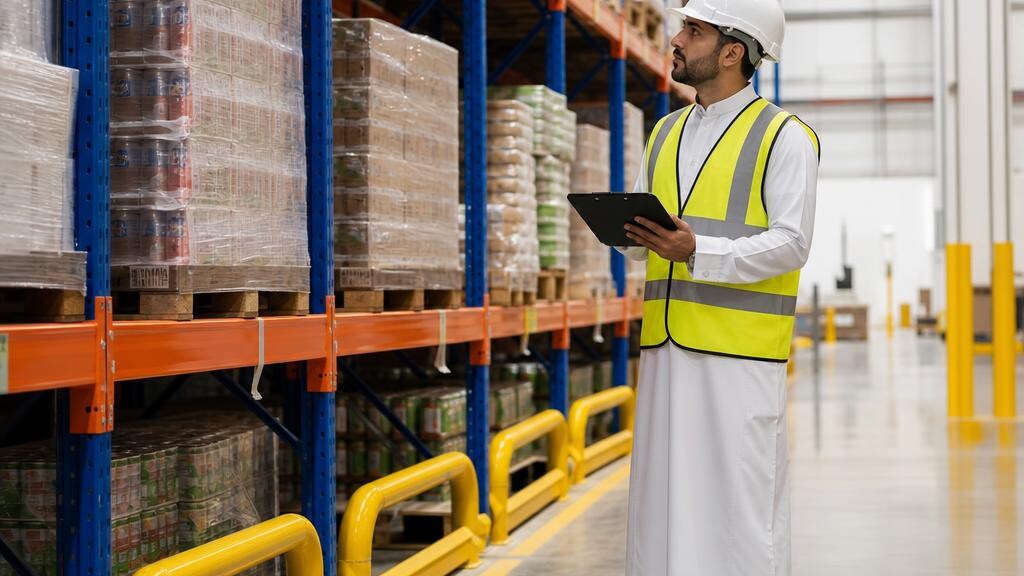
Pallet racking in Saudi Arabia must be installed, loaded and inspected to recognised safety standards — not “hacked.” Every rack should display its load rating, be inspected regularly (industry guidance from bodies such as SEMA recommends a documented expert inspection at least annually plus routine visual checks), and be repaired by competent people using original components. Under Saudi occupational-safety rules the employer or facility operator carries legal responsibility for rack safety. Four Winds operates racked, air-conditioned warehousing in Jeddah and Riyadh built and maintained to these standards.
In the world of warehousing and logistics, efficient storage management is key to optimizing operations and maximizing productivity. However, navigating the complex web of pallet racking regulations can often prove challenging for businesses seeking innovative solutions. Enter the realm of pallet racking Saudi Arabia has and its intriguing approach that unveils untapped potential within existing guidelines. This article teaches you to hack the pallet racking regulations by cleverly manipulating the established rules governing pallet racking systems. By combining a deep understanding of regulations with creative problem-solving, businesses can revolutionize their storage practices, streamline processes, and enhance overall warehouse performance. Join us as we explore ingenious techniques and insightful strategies that empower organizations to harness the full potential of pallet racking while ensuring compliance with safety standards.
Racking rules should never be treated as a loophole to exploit. The safe approach is to improve capacity within the manufacturer’s engineered limits and the facility’s fire, access and inspection requirements.
Maximizing Load Capacity in Pallet Racking Systems
Load capacity limits in pallet racking regulations often restrict businesses from fully optimizing their storage space. However, with a strategic approach, it is possible to unlock hidden potential and increase the load capacity within the regulatory boundaries. Additionally, implementing advanced technologies such as load monitoring systems and intelligent software can help accurately track and manage weight distribution, ensuring optimal utilization of the racking systems. By embracing these innovative strategies and challenging conventional norms, businesses can:
- Unlock greater efficiency
- Maximize storage capacity
- Enhance their overall productivity
All of this can be done in compliance with pallet racking regulations. Another key aspect is understanding the dynamic nature of load distribution. By analyzing load patterns and redistributing weight accordingly, it becomes possible to achieve higher load capacities without compromising safety.
Every bay should display the maximum load per level and per bay. Those figures come from the rack manufacturer’s design and should not be increased through software, load redistribution or improvised reinforcement.
Navigating Pallet Racking Regulations with Smart Aisle Clearances
When it comes to maximizing warehouse space, understanding and strategizing pallet racking regulations can be a game-changer. Specifically, focusing on clearances and aisle widths can lead to significant efficiency gains. While regulations provide guidelines for safe operations, there are opportunities to optimize space utilization without compromising safety. You can also consult about this with the pros at Four Winds Saudi Arabia.
By analyzing the specific requirements of your inventory and equipment, it is possible to hack the pallet racking regulations effectively.
Intelligent design choices, such as utilizing narrow aisle systems or implementing innovative racking configurations, can help optimize available space. Leveraging advanced technology like automated forklifts or vertical lifts can further streamline operations. By thinking outside the box and hiring freight forwarders in Dammam Saudi Arabia, businesses can revolutionize their warehouse operations, enhancing productivity and profitability.
Navigating Fire Safety Requirements in Pallet Racking
When it comes to optimizing warehouse space, understanding fire safety requirements is crucial for smooth operations and compliance. While adhering to regulations is essential, there are innovative strategies to maximize storage capacity without compromising safety. Firstly, implementing advanced fire detection and suppression systems, such as early smoke detection alarms and sprinkler installations, ensures prompt response in case of emergencies. Additionally, maintaining proper aisle widths and clearances allows for efficient movement and accessibility during firefighting efforts. Furthermore, utilizing fire-resistant materials for rack construction and incorporating fire-resistant coatings can provide an extra layer of protection. Employing a comprehensive fire safety plan, including regular inspections and staff training, is vital to prevent potential risks. By striking a balance between compliance and practicality, businesses can unlock the full potential of pallet racking while prioritizing fire safety.
Rack Labeling and Signage Compliance
When it comes to navigating pallet racking regulations, savvy warehouse operators have discovered an ingenious way to streamline their operations while maintaining compliance. The secret lies in reimagining rack labeling and signage. By utilizing a dynamic labeling system combined with strategically placed QR codes, businesses can effortlessly update and track inventory.
Rack labeling is one of the crucial ways to hack the pallet racking regulations.
They can also optimize picking routes, and enhance safety protocols. This innovative approach not only saves time and reduces human error but also unlocks the potential for real-time data analysis, allowing for proactive decision-making and efficient resource allocation. Embracing this cutting-edge solution revolutionizes warehouse management, offering a remarkable synergy between compliance and operational excellence.
Good labelling also supports inspection. Warehouses should appoint a person responsible for racking safety, record damage, and use a clear green, amber and red system so unsafe bays are unloaded promptly.
Mastering Pallet Racking Regulations
When it comes to optimizing warehouse space, understanding rack stability and bracing is paramount. While hacking regulations may sound enticing, it’s crucial to prioritize safety. Compliance with pallet racking regulations ensures a secure and efficient storage system. To enhance stability, start by utilizing proper bracing techniques. Cross-bracing beams and diagonal supports can prevent lateral movement, minimizing the risk of accidents and potential collapse. Regular inspections and maintenance should never be overlooked, as they help identify any weaknesses or issues that could compromise the stability of the racking system. By mastering rack stability within regulatory frameworks, businesses can maximize storage capacity while safeguarding their workforce and inventory. There is also the option of using a warehouse Riyadh offers to keep your inventory safe and sound anytime you need it to be.
Routine visual checks should be supported by a documented inspection from a technically competent person at least once a year. Damaged beams or uprights should be replaced with compatible original components rather than welded or mixed with parts from another system.
Mastering Inspection and Maintenance for Pallet Racking
When it comes to pallet racking regulations, diligent inspection and maintenance practices play a crucial role in ensuring optimal safety and efficiency. Regular inspections should be conducted by trained personnel to identify any signs of damage. These damages include bent beams or loose connections, which could compromise the structural integrity of the racking system.
Discovering certain hidden tactics can help you navigate the regulations while maximizing your storage potential.
Additionally, implementing a proactive maintenance schedule can prevent potential issues before they escalate, including addressing minor damages promptly and conducting routine load capacity checks. By mastering the art of inspection and maintenance, and hiring a freight forwarder in Saudi Arabia your maintenance will be on the highest level.
Innovative Approaches to Employee Training in Pallet Racking Operations
When it comes to maximizing the potential of pallet racking systems, employee training plays a pivotal role. Training the employees into using various pallet types is also a must. Traditional approaches may not always address the evolving challenges and opportunities within the industry. To hack the pallet racking regulations effectively, companies are adopting innovative training methods that promote efficiency and rack safety. One such approach is virtual reality (VR) simulations, where employees can immerse themselves in realistic scenarios and practice handling various pallet racking situations. Additionally, gamification techniques are being employed, transforming training into engaging experiences with rewards and healthy competition. This not only enhances knowledge retention but also encourages employees to embrace continuous learning. By embracing these cutting-edge training methods, companies can hack the pallet racking regulations and set themselves up for success.
FAQs
Can you legally “hack” pallet racking regulations?
No. Racking rules exist to prevent collapse and injury. What you can do is design an efficient, high-density layout that stays fully within load ratings, aisle-clearance rules and inspection requirements — which is compliance, not a workaround.
How often should pallet racking be inspected in Saudi Arabia?
Industry guidance (SEMA) recommends a documented expert inspection at least every 12 months, backed by routine visual checks by trained staff — weekly checks are common practice. Damage is graded green/amber/red, with red-risk racking off-loaded at once.
Who is responsible for rack safety?
The employer or facility operator. Best practice is to appoint a Person Responsible for Racking Safety who owns inspections, staff training and the damage register. The duty cannot be passed to individual forklift operators.
What happens if a rack beam is damaged?
Damaged beams and uprights should be off-loaded and replaced with the original manufacturer’s components. Welding or mixing parts voids the engineered load rating and is unsafe.