
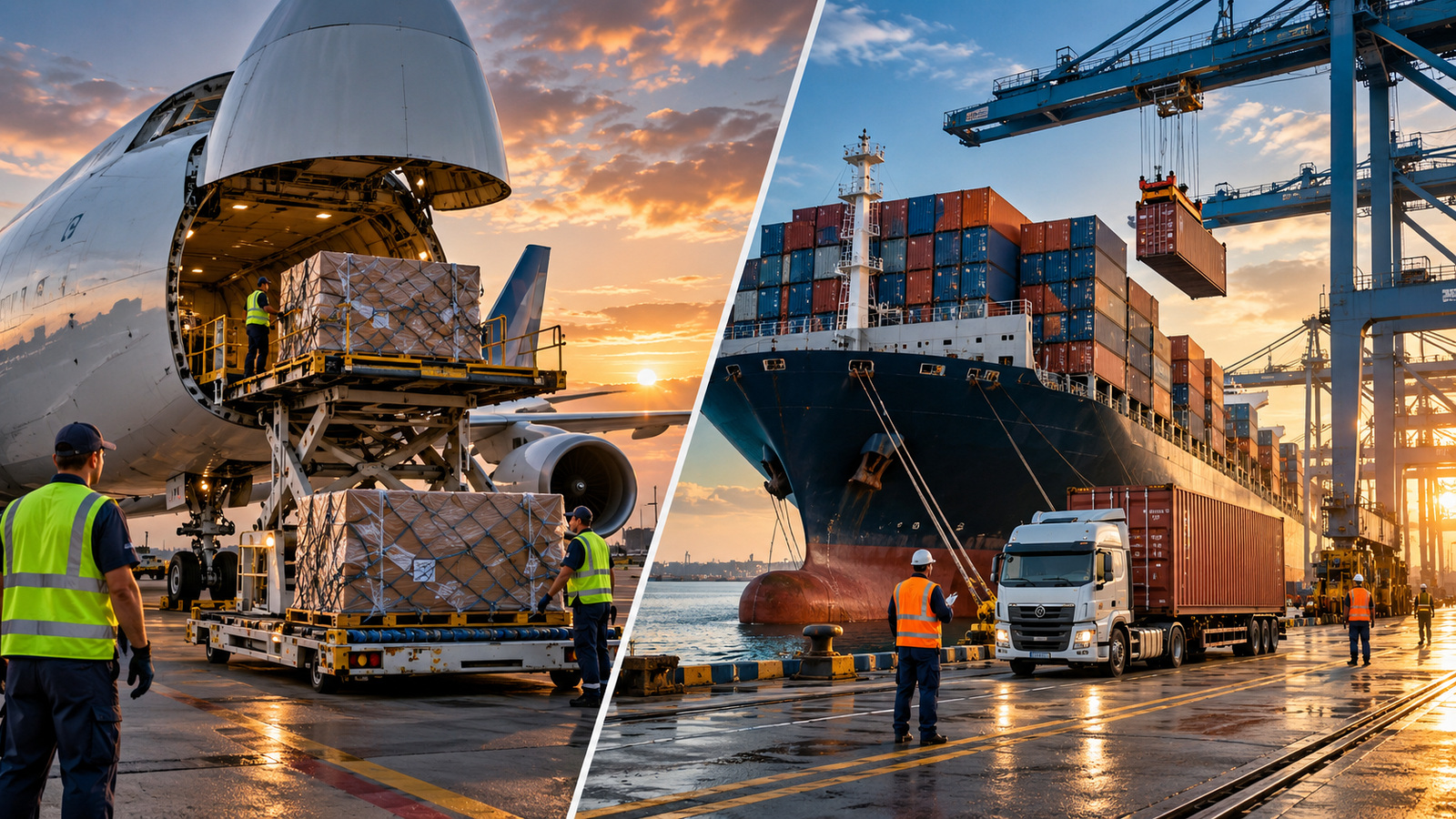
Sea freight to Jeddah or Dammam typically takes 20–35 days port-to-port and costs $0.50–$2 per kg, while air freight arrives in 3–7 days at $2.50–$8 per kg. For most household and commercial shipments into Saudi Arabia, the break-even point sits around 500 kg: below that, air freight's speed often outweighs the extra cost; above it, sea freight is 5–10x cheaper. The right choice comes down to your cargo's weight, urgency, and value.
When shipping items to another country or continent, picking the best shipping option is one of the first steps. Also, when people are moving, their household items must be transported somehow. You have two options, to ship them with either an airplane or boat. But, what are the differences and which is a better option for you? The battle between air vs sea freight transport may begin. Each side has both, advantages and disadvantages. It is only up to you and the nature of your goods.
First, choose a freight forwarding company in Jeddah that has both types of transport, so you can make a parallel. A good company is a must because even if you pick the right option for you if the company is not reliable, anything can go wrong. Such as damaged good, too expensive service, delivery not on time, you will not be able to track your shipment, etc.
Besides these two freight transport option (air and sea), there is the third option, transport by road. But, it is only used for transport within the same country or two countries between which there is no sea or ocean or are not too far away.
| Factor | Sea Freight | Air Freight |
|---|---|---|
| Typical cost | $0.50–$2/kg (LCL), often less for FCL | $2.50–$8/kg, higher for express |
| Transit time, China–Jeddah/Dammam | 20–35 days port-to-port | 3–7 days airport-to-airport |
| Best for | Shipments over 500 kg, furniture, vehicles | Shipments under 500 kg, electronics, urgent cargo |
| Weight/volume limit | Up to 28 tons per 20ft/40ft container | Chargeable weight = actual or volumetric, whichever is higher |
| Reliability | Affected by port congestion, weather, Red Sea rerouting | Fewer delays, but affected by customs holds and peak-season capacity |
| CO2 emissions per tonne-km | Lowest of the two options | 40–50x higher than sea freight |
What to consider before choosing the type of freight transport?
Choose the best option for your shipment.
Before choosing, you must know some information and you will choose wisely.
- Costs – The first factor is, of course, money. When choosing between air vs sea freight transport, you should calculate your budget. If you have a business, as a businessperson, you probably want to make more money. In most cases, sea transport is cheaper. To understand it, you should know how carriers charge. If you have heavy items to ship, it is cheaper to transport it by sea.
- Speed – If you need fast delivery, air freight is faster. Sometimes, time is money, so if you are in a hurry, choose air freight. By sea, you will wait at least 3 or 4 weeks. For business purposes, speed is a huge factor, but if you are moving your household items, it is not a bad option to wait a little longer until you finish the rest of the work you have with moving.
- Reliability – No matter if you are a businessman or individual, reliability is always welcome. Sea transport has a very long history, but air transport is more reliable. Deliveries are on time even when the flights are delayed because of the weather. Transport by sea may not arrive on time, but if a couple of days does not have a big role, then pick the sea freight.
- Environmental impact – Many people nowadays think about environmental impact and also that can change the way people look at your freight company. Taking care of the planet is one of the factors. CO2 emissions are higher in air freight transport. On the other side, there are oil spills and the water ecosystems affected by sea freight.
Air vs sea freight transport – what to choose?
Picking the right transport option is crucial for importers and individuals too. So, you should understand some new terms. Choosing between air vs sea freight transport requires collecting all the information. Here are some more facts to know.
Sea freight
For a shipment that is heavier than 100kg, you should choose sea freight because of the price. There are two types. The first is the FLC shipment (full container load). That means that your container will be filled with only your goods. The second type is LCL (less than container load) and with this type, your loads will be together with someone else’s goods together in the same container.
For large shipments, sea freight is a better option.
You can choose between a different size of FLC containers. The maximum weight of each container is 28 tons. The most usual sizes of the containers are 20 and 40 foot. Be patient, because the average time for delivery from the USA to China, for example, is 25 day.
Air freight
A good option for electronics or urgent deliveries. Air freight is commonly used for shipments of 1 cubic meter or less, for shipping small packages. It is fast, and when you need to ship a few and light items, the price is almost the same as sea transport. The shipment type is similar to LCL, but of course, in this case, it is port-to-port service.
Air freight is faster but more expensive for larger shipments.
How to calculate the volume of goods?
The formula is very simple. It is important to calculate the volume it before you ship your items because it will determine the price and type of transport. When you have to calculate goods in kgs/cbm (kilograms/cubic meter) you should first measure the length, width, and height. After that multiply it with 167 kg/cbm (or 200kg/cbm for air freight).
Calculating the volume of your goods is simple.
For example, the size of the box is 1.1m x 0.5m x 0.7m. That is 0.385 cubic meters. Multiply it with 167 and you will get 64.295 kg/cbm. If you have 5 of these boxes, the volume will be 5 times bigger (in this case 321.475 kg/cbm). When you hire a logistics company in Saudi Arabia, they will calculate it too. But having this information before the transport will help you a lot.
How Much Does Air Freight Cost vs Sea Freight in Saudi Arabia?”
Sea freight is priced by volume (cubic meter) or by container, which is why it stays cheaper for bulky or heavy shipments. A standard 20ft container holds up to 28 tons and typically costs $1,000–$2,500 door-to-port from Asia to Jeddah, depending on the season and carrier. LCL (less than container load) shipments run $0.50–$2 per kg, so a 500 kg household shipment lands around $400–$1,000.
Air freight is billed by chargeable weight — whichever is higher between actual weight and volumetric weight (length × width × height ÷ 6,000 for most carriers). A dense 500 kg shipment can cost $2,500–$4,000 at $5–$8/kg, while a light but bulky shipment of the same actual weight can cost even more once volumetric weight is applied.
When does air freight pay for itself?
Air freight is worth the premium when:
- The shipment weighs under 500 kg and speed matters more than cost.
- The goods are high-value or perishable, where a 20–35 day sea transit risks spoilage or stock-outs.
- You need to hit a fixed delivery date for a move-in, project deadline, or event.
How Long Does Sea Freight Take Compared to Air Freight into Saudi Arabia?
Port-to-port sea freight from major Chinese and European ports to Jeddah Islamic Port or Dammam generally takes 20–35 days, depending on whether the route is direct or transships through Dubai, Singapore, or Colombo. LCL shipments typically add another 4–7 days for consolidation and deconsolidations. Door-to-door timelines run 25–40 days once inland trucking and customs clearance are added.
Air freight into King Khalid International Airport (Riyadh), King Abdulaziz International Airport (Jeddah), or King Fahd International Airport (Dammam) typically takes 3–7 days airport-to-airport, or 5–8 days door-to-door once destination handling and customs inspection (including SABER certification checks where required) are factored in.
Two seasonal factors matter specifically for Saudi Arabia:
- Hajj season (Dhul-Hijjah) puts heavy pressure on Jeddah port and airport capacity — plan 1–2 extra weeks either way.
- Ramadan and Eid holidays reduce customs and bank working hours, which slows clearance on both modes.
Which Ports and Airports Handle Freight in Saudi Arabia?
Saudi Arabia’s freight infrastructure is split between the Red Sea and the Arabian Gulf coasts, so the right entry point depends on where your shipment is heading:
- Jeddah Islamic Port — the Kingdom’s principal port, best for shipments to Jeddah, Mecca, Medina, and the Western Region.
- King Abdullah Port (Rabigh) — a newer, less congested alternative for Western Region cargo.
- Dammam (King Abdulaziz Port) — the main Gulf port, serving Riyadh, the Eastern Province, and industrial cargo.
- King Abdulaziz International Airport (JED) — primary air freight gateway for the Western Region.
- King Khalid International Airport (RUH) — best for nationwide distribution from Riyadh.
- King Fahd International Airport (DMM) — serves Eastern Province and industrial air cargo.
Choose professionals
Choosing between air vs sea freight comes down to your shipment’s weight, timeline, and budget — there’s no single right answer for every move. Four Winds Saudi Arabia handles both freight modes through Jeddah, Dammam, and Riyadh, and can also advise on the carbon footprint of air and sea freight if sustainability is part of your decision.
Get a free shipping estimate and our team will recommend the mode that fits your cargo and deadline.
FAQs
Is air freight or sea freight cheaper for moving to Saudi Arabia?
Sea freight is cheaper for shipments over 500 kg, running $0.50–$2 per kg versus $2.50–$8 per kg for air freight. Below 500 kg, the gap narrows and air freight's speed often justifies the extra cost.
How long does sea freight take from China to Jeddah or Dammam?
Port-to-port sea freight typically takes 20–35 days, with LCL shipments adding 4–7 days for consolidation. Door-to-door timelines run 25–40 days once customs and inland trucking are included.
How long does air freight take to Saudi Arabia?
Air freight typically arrives in 3–7 days airport-to-airport, or 5–8 days door-to-door including customs clearance.
an I combine air and sea freight for the same shipment?
Yes. Many clients ship urgent or high-value items (electronics, documents) by air and send bulkier furniture and household goods by sea, arriving separately but planned around the same move-in date.
Does Hajj or Ramadan affect freight delivery times in Saudi Arabia?
Yes. Hajj season adds pressure to Jeddah's port and airport capacity, and Ramadan/Eid holidays reduce customs working hours — both can add one to two weeks to either shipping mode.