
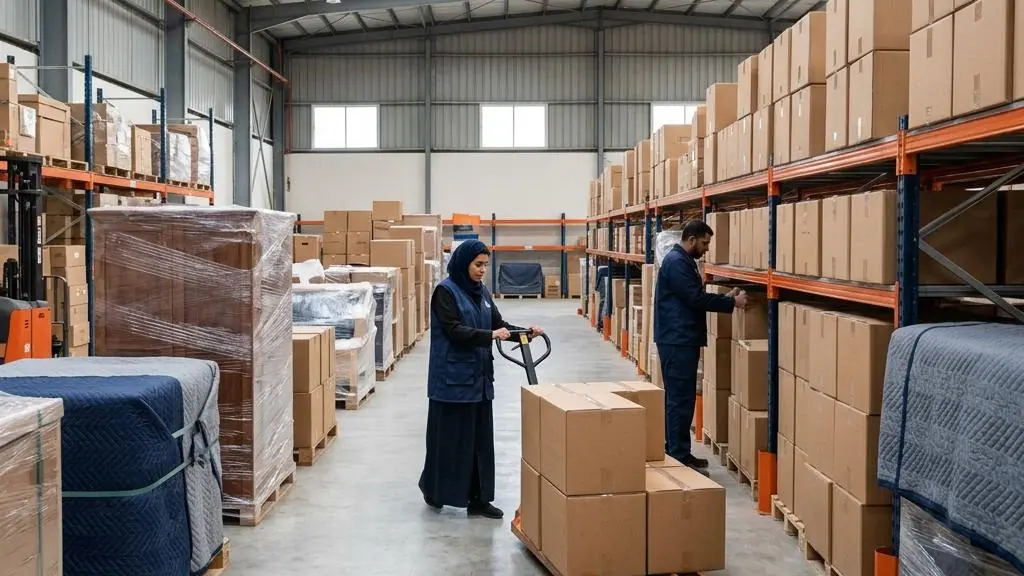
Long-term warehousing solutions in Saudi Arabia help businesses protect inventory, maintain supply chain stability, and meet regulatory requirements. Climate-controlled storage is especially important due to the Kingdom's extreme temperatures. Choosing the right warehouse provider can reduce costs, improve inventory management, and support long-term business growth.
A warehouse may be defined as a place used for the storage or accumulation of goods. But in Saudi Arabia, that definition barely scratches the surface of what a warehouse actually needs to do. Ocean freight to Saudi Arabia arrives at one of the hottest port environments in the world, and the goods that come off those vessels face conditions that make storage decisions consequential in ways that simply do not apply in temperate markets. Here are five reasons why long-term warehousing solutions in Saudi Arabia require careful planning — and why the type of facility matters as much as the price.
Five reasons for long-term warehousing solutions
The potential downsides to warehousing are far outweighed by the benefits of secure storage, inventory visibility, and improved business continuity.
Forget about tasks such as sorting, order picking, packaging, shipping, distribution, kitting, postponement, etc. Instead, you can use warehousing services for managing both your supply chain and inventory. Get in touch with your movers in Jeddah so they can take care of storing your goods.
Using long-term warehousing solutions you keep your goods safe.
1. Saudi Arabia’s climate makes temperature control a business necessity, not a luxury
In most of the world, temperature-controlled storage is a premium service for a specific category of goods. In Saudi Arabia, it is the baseline requirement for a much wider range of products than most businesses initially appreciate. The Kingdom’s summer temperatures — regularly exceeding 45°C in Riyadh and inland areas, with high humidity on the Red Sea coast adding stress even where peak temperatures are slightly lower — affect goods that would store safely in ambient conditions elsewhere.
Electronics degrade in sustained heat. Adhesives in packaging fail. Cosmetic formulations separate. Paper documents discolour and deteriorate. Battery-powered items suffer accelerated battery degradation before they have even reached a retail shelf. For any business storing goods in Saudi Arabia through the summer months, the question of whether temperature control is needed must be answered specifically for the Saudi climate — not by reference to storage standards in Europe or North America.
2. Regulatory compliance demands it for growing product categories
Saudi Arabia’s regulatory environment sets specific storage requirements for an expanding range of product categories, and the standards are enforced.
- Pharmaceuticals: The Saudi Food and Drug Authority (SFDA) requires GDP (Good Distribution Practice) compliance for all pharmaceutical storage and distribution. This means defined temperature ranges — typically 2–8°C for refrigerated medicinal products, 15–25°C for controlled room temperature goods — continuous monitoring with calibrated data loggers, documented deviation procedures, and staff trained in pharmaceutical handling. A standard warehouse, even an air-conditioned one, is not SFDA GDP-compliant without the accompanying quality management system.
- Clinical trials: Clinical trial materials — Investigational Medicinal Products (IMPs) — face particularly strict storage requirements, often exceeding those for commercial pharmaceutical products. The documentation chain from manufacturer to storage to trial site must be complete and auditable. Our clinical trial logistics service is designed specifically for this requirement.
- Cold chain for food imports: SASO standards for food safety in Saudi Arabia include requirements for cold chain maintenance from port to warehouse to retail. Perishable food imported through Jeddah Islamic Port must move into compliant cold storage promptly after customs clearance.
Take everything into consideration before choosing your warehouse.
3. Supply chain stability — the case for buffer stock
Saudi Arabia’s import dependency for many product categories makes domestic warehousing a strategic supply chain decision, not just an operational one. The Red Sea crisis of 2023–2024 was a dramatic demonstration of something that logistics professionals in the Kingdom already knew: a supply chain with no buffer stock has no resilience when shipping lanes are disrupted.
Long-term warehousing (holding two to four weeks of buffer stock rather than running on just-in-time supply) costs money in storage fees. It costs considerably more when sea freight disruption means a vessel is two weeks late and production halts or retail shelves empty while the delayed container makes its way via an alternative route. The underlying argument applies whenever lead times extend for any reason: port congestion, customs delays, carrier scheduling changes, or seasonal demand spikes that outrun replenishment cycles.
4. Long-term provider relationships reduce total cost
The stability that matters most is operational stability — knowing that your goods are in a facility that can be relied upon, with staff who know your inventory, at a provider that can also handle customs clearance, transport, and distribution without requiring you to coordinate multiple vendors.
A long-term warehousing relationship with a provider like Four Winds means your goods are stored in air-conditioned facilities with pallet racking that enables efficient stock management, alongside the cargo transportation and customs clearance services that get goods in and out without the delays and miscommunications that arise when warehousing and logistics are handled by separate providers. The cost saving from consolidating these services is real and compounds over time.
When comparing providers, businesses should look beyond rent alone and account for the extra costs associated with managing multiple vendors, transportation delays, inventory handling, and climate-controlled storage requirements.
5. Seasonality and demand variation require flexible storage capacity
Saudi Arabia’s retail calendar creates demand patterns that are not evenly distributed across the year. Ramadan, Eid, the Hajj season, and the Vision 2030-driven expansion of tourism and events all create specific demand peaks for particular product categories. Businesses supplying the Saudi market need warehousing that can scale with these peaks — holding more stock in advance of a peak period, then releasing it — without locking the business into year-round full-capacity costs.
Get in touch with our movers in Jeddah team to discuss the right warehousing arrangement for your business’s volume profile. Whether your requirement is short-term, long-term, climate-controlled, or standard storage, Four Winds offers solutions that scale to your actual needs.
Types of warehouses you need to know for long-term warehousing solutions
Regarding the long-term warehousing solutions, you should have in mind that there are three types of warehouses.
- Private warehouses – Owned and operated by big manufacturers and merchants to fulfill their own storage needs. Manufactured or purchased goods by the owner have limited value. A big manufacturer may have a network of his own warehouses in different parts of the country.
- Public warehouses – Provide storage facilities to the general public for a fee. Individuals can own it as well as a cooperative society. They are very important in the marketing of agricultural products. That is why the government encourages the establishment of public warehouses. They are very useful to the business community. Small manufacturers and traders can rent this type of warehouse for a low price. You will mostly find them near the junctions of railways, highways, and waterways.
- Bonded warehouses – Are licensed by the government to accept imported goods for storage until the payment of customs duty. You will usually find them near ports. Bonded warehouses are very helpful to importers and exporters. If an importer is unable or unwilling to pay customs duty immediately after the arrival of goods he can store the goods in a bonded warehouse. After the custom duty is paid, goods are free to go.
There are three types of warehouses.
Choosing the right long-term warehousing strategy
No matter which type of warehouse you choose it should have good software that can help your inventory management and warehousing operations. Another great benefit of the software is that it lets you track the order fulfillment process in real-time. Choosing the right long-term warehousing solutions can help save money, depending on your preference. And also meet the customer’s demands. Working with a third-party logistics company is very common for eCommerce businesses that don’t want to manage a warehouse themselves.
FAQs
What is the difference between cold storage and air-conditioned warehousing in Saudi Arabia?
Air-conditioned warehousing maintains a general cool environment — typically 18–25°C — which protects goods from Saudi Arabia's extreme ambient heat but does not provide the precise temperature control required for cold chain products. Cold storage maintains specific refrigeration ranges: 2–8°C for most refrigerated pharmaceutical products, below -18°C for frozen goods. Pharmaceuticals and clinical trial materials need cold storage, not just air-conditioned storage, and the regulatory distinction matters for SFDA compliance.
How long should I hold buffer stock in a Saudi Arabia warehouse?
There is no universal answer — it depends on your product category, import route, and risk tolerance. A practical starting point: identify your longest realistic lead time extension (if sea freight from your primary origin can be delayed by two to three weeks in a disruption scenario), and hold at least that amount of buffer stock. For Saudi businesses importing from Europe via the Red Sea/Suez route, a three to four week buffer is a reasonable baseline for non-perishable goods.
Are there downsides to warehousing in Saudi Arabia?
The main challenges are cost and compliance rather than fundamental drawbacks. Climate-controlled storage is more expensive than ambient storage due to the cost of operating air conditioning year-round in Saudi Arabia's climate. Regulatory compliance for certain product categories adds to the operating cost of a compliant warehouse. Working with an established logistics provider reduces both challenges significantly by spreading fixed infrastructure costs across multiple clients.
Can Four Winds handle both warehousing and customs clearance for imported goods?
Yes. Four Winds provides integrated warehousing, customs clearance, cargo transportation, and freight forwarding services, meaning goods can be cleared, stored, and distributed through a single provider. This integration is particularly valuable for businesses managing time-sensitive imports — having your customs broker and warehouse provider as the same company eliminates coordination delays that arise when different vendors handle different parts of the process.