
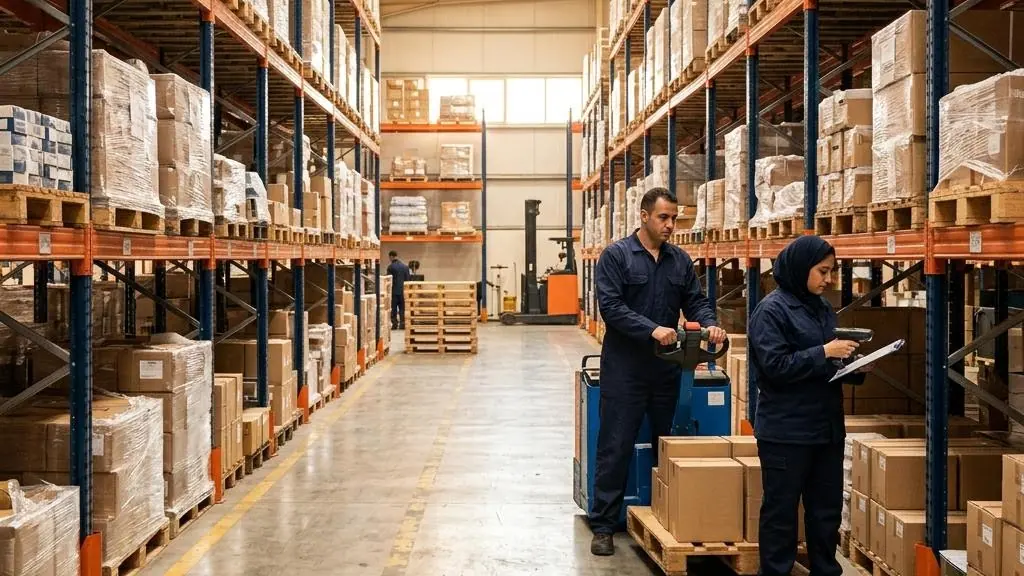
Saudi Arabia is a major logistics hub connecting Asia, Europe, and Africa, driving strong demand for warehousing services. Climate-controlled storage is essential for many goods due to the Kingdom's extreme temperatures. Continued investment through Vision 2030 is helping expand warehousing capacity, technology, and supply chain efficiency.
Saudi Arabia plays a key role in regional and global warehousing. As the strongest connection between Asia, Europe, and Africa, the Kingdom’s position makes it a natural logistics hub — and its warehousing market has grown significantly as a result. The development of Vision 2030 infrastructure, the expansion of shipping and logistics companies, and the sustained growth of e-commerce have all contributed to rising demand for storage capacity across the country. This article gives a practical overview of the Saudi Arabia warehousing market, with a focus on what businesses and individuals actually need to know before choosing a facility.
What is warehousing and why it matters in Saudi Arabia
Warehousing is the process of storing goods for sale or further distribution. It plays a crucial role in the supply chain — without warehousing, it would not be possible to transport goods and inventory effectively, especially for overseas shipments. Warehouses are used by manufacturers, importers, exporters, transportation businesses, and customs intermediaries. Their primary aim is to store products safely, in an organised way, tracking location, condition, arrival date, and planned departure.
In the Saudi Arabia context, warehousing carries additional significance because of the Kingdom’s climate. Summer temperatures regularly exceed 45°C in inland areas. Goods that would store safely in ambient conditions in Europe or North America can be damaged, degraded, or rendered unsellable in Saudi Arabia’s summer heat without appropriate climate control. This makes the type of warehouse — not just its size or location — a material business decision.
The demand for storage space is growing quickly
Warehouse services available in Saudi Arabia
Saudi Arabia’s warehousing providers offer a range of service levels beyond basic storage:
- Order fulfilment: packing, crating, labelling, and dispatch coordination
- Inventory management: real-time tracking of stock levels, locations, and condition
- Pallet racking: structured storage systems that maximise vertical space utilisation
- Cross-docking: goods distributed directly to customers with minimal intermediate storage
- Transloading: transferring goods between transport modes — for example, from container to truck for final delivery
Climate-controlled and cold storage: temperature-managed environments for sensitive goods (see below)
The importance of air-conditioned warehousing in Saudi Arabia
Air-conditioned warehousing is not a premium service in Saudi Arabia — it is a baseline requirement for many categories of goods. The Kingdom’s ambient temperatures between May and September make standard non-climate-controlled storage inadequate for a wide range of products:
- Pharmaceutical and healthcare products: SFDA GDP guidelines require defined temperature ranges for medicinal products. A standard warehouse with no temperature control is non-compliant for pharma storage.
- Electronics and electrical goods: heat causes battery degradation, circuit board warping, and failure of adhesive bonds. Extended storage in non-air-conditioned facilities shortens the effective life of electronics significantly.
- Food and beverages: perishable and semi-perishable goods require cold chain or climate-controlled storage to maintain quality and comply with SASO food safety standards.
- Cosmetics and personal care products: many formulations are heat-sensitive and separate or degrade in sustained high temperatures.
- Documents and media: paper documents, photographs, and media stored without climate control deteriorate significantly faster in Saudi Arabia’s climate than in temperate conditions.
Four Winds operates air-conditioned warehouse facilities in both Jeddah and Riyadh. Details of our warehouse services including climate-controlled storage, pallet racking, and short and long-term options are on our warehouse page.
Warehousing in Saudi Arabia’s key cities
The largest warehousing areas are in the cities of Riyadh, Jeddah, and Dammam. Even though Jeddah has the main revenue share, Dammam and Riyadh stand close.
- Jeddah: a port on the Red Sea that has a warehousing area of 26.1 million square meters.
- Dammam: its warehousing districts occupy 20.9 million square meters. If you need storage services, you can always rely on our logistics company in Dammam.
- Riyadh: the capital of Saudi Arabia. Its warehousing area stretches 24.5 square meters, and they are mainly close to Riyadh’s dry port.
Jeddah — the primary warehousing hub
Jeddah generates the largest share of warehousing revenue in Saudi Arabia, driven by its position as the Kingdom’s primary sea freight gateway. Jeddah Islamic Port is the entry point for the majority of Saudi Arabia’s containerised imports. Warehouses proximate to the port serve holding, customs clearance, and onward distribution functions that no other city in the Kingdom replicates at the same scale.
The industrial zones on Jeddah’s northern and eastern periphery host the highest concentration of logistics and warehousing facilities in the Western Region. For businesses importing goods through Jeddah Islamic Port, warehousing close to the port reduces dwell time and port storage charges — a significant cost saving on high-volume or time-sensitive shipments. Our warehouse Jeddah facility provides air-conditioned storage with direct operational links to port clearance.
Warehousing in Saudi Arabia has always been increasing
Riyadh — the distribution centre for the Central Region
Riyadh is the second largest warehousing market in Saudi Arabia by revenue share and the primary distribution hub for the Central Region. Its position equidistant from Jeddah (950km) and Dammam (400km) makes it the natural consolidation and re-distribution point for goods entering the Kingdom from either the Red Sea or Gulf side. The expansion of King Khalid International Airport and the planned Riyadh Dry Port — a major Vision 2030 infrastructure project — will significantly increase Riyadh’s capacity as a logistics and warehousing hub in coming years. Our warehouse Riyadh facility serves businesses requiring Central Region distribution support.
Dammam — the Eastern Province logistics gateway
Dammam and the Eastern Province host the Kingdom’s oil and gas industry and several of its major industrial cities. King Abdulaziz Seaport in Dammam handles significant cargo volumes, particularly for goods moving to and from Asia. Warehousing in Dammam serves the industrial corridor including Jubail Industrial City and the Aramco supply chain ecosystem.
Saudi Arabia offers different types of storage, including climate-controlled ones
Warehousing in Saudi Arabia: advancements
In order to fulfill the Vision 2030 goals, logistics Saudi Arabia set up some advancements as possible solutions. Due to these solutions, storage services in Saudi Arabia went forward. Here are some of the most notable ones:
- Cold storage: Being aware of pharmaceutical needs due to Covid-19 Pandemic, Saudi Arabia found a way to store vaccines and medicines. Saudi Arabia introduced cold storage option.
- On-demand warehousing: Businesses that need to store their inventory can access warehouse solutions temporarily. It means they can pay as they go.
Technology advancements
The warehousing industry uses advanced technology to improve efficiency and make the workflow easier. It seems like technology advancements will continue to integrate into the industry. Here are some of the most important advancements:
- Block-chain: artificial intelligence is a trend in many industries, and warehousing is not an exception. The most notable trend is block-chain technology. It helps to strengthen the shipping logistics and facilitate trade and storage. It is very useful, especially in seaports. Most importantly, it makes the whole supply chain more transparent.
- IoT: The Internet of Things also improves transparency across the supply chain network. IoT devices are attached to shipments so that companies can track the shipment in real-time. It contributes to the faster and safer flow of goods.
- APIs: these systems help software fulfill orders, manage inventory, and allow warehouses to communicate with each other. This makes the warehousing process easier and enables warehouses to connect with other supply chain parts.
Warehousing trends
Warehousing requires a lot of strategies in order to ensure operational success. That’s why companies implement new trends. And alongside the automation trends mentioned above, logistics Saudi Arabia will implement some new ones. Maybe the most important trend is sustainable warehousing in Saudi Arabia. Why? More and more businesses will be looking for green warehousing. Besides carrying for the plane an eco-friendly business will reduce utility bills. Wonder how to ensure sustainable warehousing? Well, it’s simple. Businesses will invest in energy-efficient equipment. Also, warehouses are implementing recycling plans. Then, they’ll use less packing or more eco-friendly packing supplies. So, synthetic and plastic materials will be changed with biodegradable materials. This will reduce the waste and also the carbon footprint.
Insulation of warehouse
If insulation is poor, it may disrupt the warehouse temperature. It leads to additional bill expenses. What’s more, your impact on the environment increases. So, ensure to have your warehouse properly insulated. This way, you won’t only protect the environment, but you’ll also keep your warehouse climate-controlled. Besides, you’ll reduce the risks of damaging the warehousing items.
Last-mile deliveries
Last-mile delivery is a trend that happened thanks to e-commerce, especially during the pandemic. According to Statista, e-commerce sales increased almost 21.5 percent in 2019. It is estimated that in 2022, it will increase even more. That’s why business starts following this trend. Fast delivery, even the same-day delivery, will be on top of their priorities. And this leads to the demand for last-mile facilities. They will help in delivering the goods quickly and frequently. So, more and more businesses will implement last-mile facilities in their supply chain.
Drone Introduction
In 2022, the introduction of drones will be a trend many businesses will follow. Why? Well, the benefits are many. The first benefit is that drones are able to spot items in no time. It will facilitate the job of warehouse employees.
The use of technology is the latest trend in warehousing in Saudi Arabia
Warehousing in Saudi Arabia: challenges
The world has faced many warehousing challenges due to the Coronavirus pandemic, so has Saudi Arabia. It has hugely impacted its logistics, and Saudi Arabia has to face some obstacles to keep the warehousing expansion. Here are some main challenges that logistics managers face:
- Supply chain interruptions: this happened due to Covid-19, and it may continue to interrupt the supply chain since the situation constantly changes. However, logistics companies develop their strategies to keep the supply chain unbreakable.
- E-commerce: Online commerce also expands quickly, and suppliers may still struggle to meet all demands.
- Warehouse again: This is the most common challenge. An increase in demand constantly changes, e-commerce develops, and technology is required. That’s why it’s challenging to keep the warehouses automated and up-to-date.
Challenge solutions
Warehousing challenges happen every day, and they’ll continue to happen in the future. That’s the beauty of logistics. So, logistics managers will have to meet the challenges and come up with solutions. The first solution is to establish close proximity to suppliers. By minimizing the goods-traveling distance, logistics managers reduce the ineffectiveness. Next, as already mentioned, businesses should introduce warehouse automation to avoid warehouse aging. The introduction of technology will also help with dealing with e-commerce challenges. Besides, more space should be created as the demand is increasing. Then, a larger workforce should be created, too. Most importantly, warehouse modernization and digitalization are essential in overcoming the challenges. And last but not least, logistics managers in Saudi Arabia should make strong warehouse systems. This way, the workflow will be optimized.
Warehousing constantly requires changes
Vision 2030 and the Saudi warehousing market
Saudi Vision 2030 identifies logistics as a strategic sector, with specific targets to increase the Kingdom’s position in global logistics indices and to develop it as a transshipment hub connecting Asia, Europe, and Africa. The practical infrastructure investments affecting warehousing include:
- King Salman Energy Park (SPARK): a major industrial and logistics zone in the Eastern Province serving the energy sector
- Jeddah Islamic Port expansion: ongoing investment to increase container handling capacity and reduce vessel turnaround times
- Riyadh Dry Port: planned inland container terminal that will provide Riyadh with dedicated container logistics infrastructure
• Special Economic Zones: King Abdullah Economic City (KAEC) near Jeddah and the Special Integrated Logistics Zone at King Abdulaziz International Airport both include warehousing and logistics facilities with regulatory incentives for foreign operators
Need storage space? Four Winds Saudi Arabia should be your choice
Now that you’ve read an overview of warehousing in Saudi Arabia, you’ve realized the importance of proper storage. Your goods need to have a strong logistics background to reach the customers. Four Winds Saudi Arabia offers a plethora of services. You can choose from cargo transportation, customs clearance, freight forwarding, cold chain services, packing and crating, warehousing, etc. Four Winds Saudi Arabia is one of the leading logistics companies in KSA. With us by your side, you won’t have to worry whether your goods will arrive on time. Our logistics plans are very detailed. So, if you need warehousing service or any other service, contact us today. By using our warehouse, you’ll save money, improve business productivity, reduce the possibility of goods damage and theft. And, most importantly, you’ll get a safe place for storing. You can be sure that we’ll meet all of your requirements.
FAQs
What is the difference between air-conditioned and cold storage warehousing in Saudi Arabia?
Air-conditioned warehousing maintains a general cool, dry environment — typically 18–25°C — suitable for electronics, cosmetics, documents, and goods that need protection from extreme ambient heat but do not require refrigeration. Cold storage maintains lower defined temperatures (2–8°C for refrigerated pharma products, or below -18°C for frozen) and is required for pharmaceutical products under SFDA GDP guidelines, fresh food, and frozen goods. The distinction matters for regulatory compliance — some product categories are non-compliant if stored in air-conditioned rather than properly refrigerated conditions.
Why is Jeddah the most important warehousing city in Saudi Arabia?
Jeddah Islamic Port is the primary gateway for Saudi Arabia's containerised sea freight imports, and warehouses close to the port serve the holding, customs clearance, and distribution functions this trade volume requires. Jeddah also serves as the distribution hub for the Western Region, which includes Makkah, Madinah, and the Red Sea coast. Its combination of port infrastructure, industrial zones, and road connectivity to Riyadh makes it the largest revenue generator in the Saudi warehousing market.
Can I rent warehouse space in Saudi Arabia as a foreign company?
Yes, with the appropriate commercial registration. Foreign companies operating in Saudi Arabia typically do so through a licensed local entity or a Special Economic Zone structure. KAEC, the Special Integrated Logistics Zone, and other free zones offer specific frameworks for foreign logistics operators. MISA (Ministry of Investment of Saudi Arabia) is the primary regulatory body for foreign investment applications in logistics.
What services does Four Winds provide alongside warehouse storage in Saudi Arabia?
Four Winds offers air-conditioned warehousing in Jeddah and Riyadh alongside cargo transportation, freight forwarding, customs clearance, and packing and crating services. Goods stored in our facilities can be received, cleared through customs, stored, and dispatched domestically or exported internationally through a single integrated service. Contact us to discuss the right package for your requirements.